



AI & Automation: Making Paper Documents Accessible
The federal government, the states, and local governments want to promote the use of artificial intelligence. However, AI applications such as Intelligent Document Processing are of little use as long as relevant information remains tied up in archived paper files.
Government agencies have extensive data sets, but a large portion of this data is still available only in paper form. Registers, construction files, personnel files, and archives contain large amounts of information that has not been digitized. As long as this information remains on paper, it is inaccessible to automation solutions such as Intelligent Document Processing (IDP).
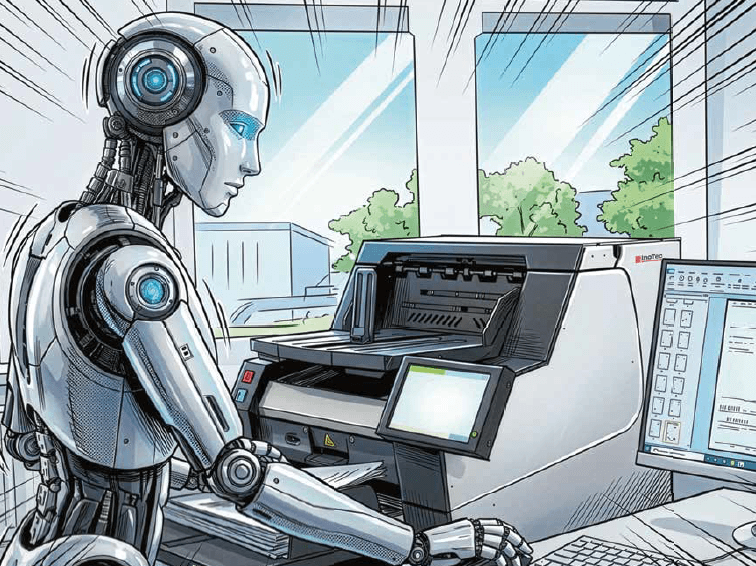
Document Scanners as a Gateway to AI
By classifying documents, consolidating content, extracting information, and streamlining business processes, IDP promises tangible efficiency gains in document management. But amid all the excitement, one thing is often overlooked: Any AI is only as good as the data it receives.
Anyone who wants to unlock the potential of AI must therefore first take a less “trendy,” but fundamental step: Paper needs to be scanned. A document scanner thus provides the raw material for IDP systems. A basic requirement here is that high-quality images are consistently produced. If, on the other hand, these images are blurry, warped, or incomplete, it leads to rework and misclassifications.
Theoretical scan speeds are only of limited help when selecting a scanner. In government agencies, the only thing that counts is actual throughput: How many documents can be processed without jams, double feeds, or special handling? How reliably does the scanner handle mixed stacks of thin paper, folded notices, thick documents, and extra-long forms? How consistently does it perform over the years? Four key quality factors are decisive: reliability, user-friendliness, flexibility, and efficiency.
In terms of its mechanics, wear and replacement parts, and support, a professional document scanner is designed for continuous operation. Paper-friendly feeding and belt transport, configurable ultrasonic sensors, and reliable staple detection prevent misfeeds and jams. Scratch-resistant glass guides and integrated image optimization ensure consistent quality. Reliability should therefore rarely, if ever, pose a truly serious problem.
When it comes to flexibility, however, the situation can be quite different; after all, the public sector rarely scans only “off-the-shelf” materials—that is, standardized formats. A professional system processes and sorts different formats and paper qualities—from delicate old files to cardboard-reinforced envelopes. Variable feed forces, adjustable scan speeds, a straight paper path, event-based sorting, and open interfaces to DMS, e-file, and IDP solutions expand the range of applications.
When examining user-friendliness in detail, intuitive, ergonomic operation, clear plain-language messages, and easily accessible paper paths are essential. Meanwhile, predefined scan profiles and project-specific speeds streamline recurring tasks, thereby improving efficiency. Processes based on the BSI’s Technical Guideline TR-03138 “Replacement Scanning” (RESISCAN) also lay the foundation for traceable, legally compliant digital documents.
Laying the Groundwork for Decision-Making
Procurement and AI strategy must not stop at the algorithm. Anyone investing in IDP and automated business processes should also consider the upstream digitization—from document preparation and scan quality to metadata and quality assurance. Verified user reports from comparable government agencies, as well as test installations using the organization’s own documents and real-world workflows, are particularly insightful.
The author:
Steffen Unmuth is Chief Commercial Officer
of DATAWIN GmbH / InoTec SCAMAX

Recent Comments